
Taxis and Kinesis (A-level Biology)
Taxis and Kinesis
Stimuli
Internal and External Environment
A stimulus is any change to an internal or external environment.
An organism needs to respond to changes in both their:
- Internal environment – maintaining a stable internal environment ensures optimal internal conditions for metabolism (all the reactions of the body). For example, if blood glucose levels rise after a meal, insulin is released by the body in a negative feedback system.
- External environment – organisms must react to things like temperature differences to stay in their optimal conditions. For example, if the temperature falls, the hair erector muscles contract leading to hair standing to on end, alongside other changes such as vasoconstriction in the skin capillaries.
Simple Responses
Taxes and Kinesis
Taxes and kineses are types of simple responses that can keep a mobile organism (e.g. an earthworm) in a favourable environment.
-
-
-
- Tactic responses are directional responses to stimuli. Phototactic responses are a type of tactic response to light. Maggots show a negative phototactic response to light, so they move away from the source.
-
-
-
-
-
- Kinetic responses are non-directional movements in order to move to more favourable conditions. For example, woodlice prefer damper conditions. If an environment is too dry, the woodlice will move in random directions (non-directional), until they find a damper spot. Once in an area with higher humidity they will turn less and move slower, increasing the chance of remaining in a damp, more favourable environment.
-
-
Choice Chambers
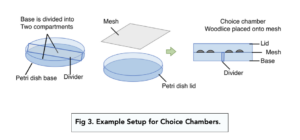
We already know how small organisms such as woodlice use kinetic responses to find favourable conditions. We can test this using choice chambers – containers with different compartments which can simulate different environmental conditions, such as humidity and light intensity.
Method:
- Set up a choice chamber. The chamber should have one half in natural daylight, the other half covered by black paper to simulate darkness.
- Add woodlice into the chamber. Place 10 woodlice in the centre of the choice chamber
- Record your results after 10 minutes. After 10 minutes, record how many woodlice are in each section. You can repeat by placing the woodlice back into the centre of the chamber.
You can change the independent variable to measure to woodlouse’s preference for humidity. Use a damp filter paper for one half of the choice chamber, and a drying agent on the other.
The woodlice will prefer to be in darker, damper conditions, so a greater number will be on these sides of the choice chambers.
Still got a question? Leave a comment
Leave a comment