
Pacinian Corpuscle (A-level Biology)
Pacinian Corpuscle
Detecting Pressure
Pressure Receptors in Skin
- The Pacinian corpuscle is a type of touch receptor that responds to pressure.
- These receptors are also called mechanoreceptors, meaning that they detect pressure and vibrations. They are found in the skin, fingers and toes.
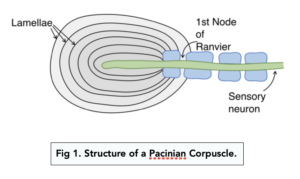
- The corpuscle is comprised of many layers of lamellae, a type of connective tissue. The tissue is wrapped around the end of a sensory neurone.
Stimulation of a Pressure Receptor
The following steps lead to an action potential:
- The corpuscle is compressed by the stimulus. When pressure is applied, the lamellae become deformed, changing the shape of the corpuscle.
- Stretch-mediated Na+ ion channels open. The membrane of the sensory nerve cell stretches, causing ion channels to open.
- Na+ ions move into the sensory neurone. This causes a generator potential, which can cause an action potential.
The Pacinian corpuscle will only respond to mechanical stimuli – it is specific.
Still got a question? Leave a comment
Leave a comment